Friday, April 26, 2024

Jab jitters
Problems from needles


As a public service, NEWS of the WORLD reprints The FUNNY STUFF FUNNIES, an educational comic book giving basic facts on drugs and alcohol. Each post reproduces a page from the booklet, which is aimed at young persons and which avoids sermonizing and excessive wordiness.

X
JB1
Tap phone images for better views.
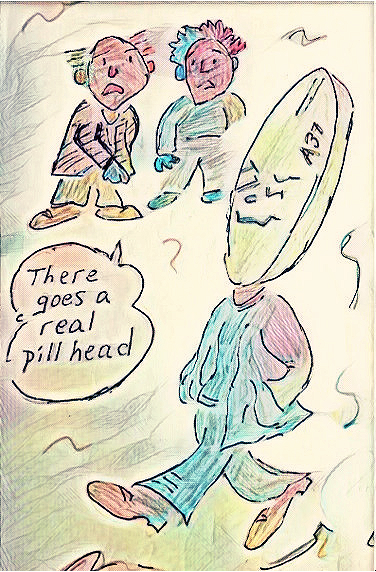
Many young people who start out popping prescription pain pills would never dream of shooting up with syringes. Yet that's the road they travel. The pills are pricey and as their need for them worsens, they find relief for their cravings with a cheaper pain-killer: heroin. Various drugs are commonly injected into the body via hypodermic needles as a means of delivering a "big, fast bang for the buck."

The three types of injection are:
✓ IV, or intravenous. The needle is inserted into a vein so that the drug is transmitted to the brain receptors rapidly in an undiluted form. The effect -- or "rush" -- takes a few seconds.

✓ Muscle. The needle is inserted into a muscle, so that a user need not find a vein. (Veins tend to collapse as the number of needle jabs goes up.) The chem is felt within minutes.

✓ Skin-popping.  The needle  is inserted at an angle  so that it goes under the skin, where the chem soaks into the capillary system. The chem starts acting within minutes.
JB2
Health effects of needle use
If needles were always sanitary, the risk of death or disease would be considerably lower among users. But, even careful users are likely to run into situations where their need is so strong that they think nothing of sharing a needle with another addict.

Also, if the needle is clean but the syringe is not, disease can spread. The entire set of "works" must be clean.

So a number of viruses are circulating today among addicts everywhere because they go from one user's blood stream to another via unclean hypodermic needles.

Among the diseases are:
✓ HIV-Aids. Tho treatment of this disease has improved greatly in recent years, even so it is a disease you can do without. You may be getting expert care and good medicines, but your quality of life and life expectancy are still quite negatively affected.

✓ Hepatitus (both Type B and Type C). Chronic hepatitis B or C can result in serious, even life-threatening health problems like cirrhosis and liver cancer. People with chronic hepatitis often have no symptoms and don’t feel sick. By the time symptoms do appear, the liver may be in very bad shape. If caught in time, the diseases can be treated with anti-virals, such as Interferon. Such treatrment can be lengthy and unpleasant.

✓ Dangerous bacterial infections. Abscesses, if left untreated, can develop into major problems. Untreated septicemia -- blood poisoning by bacteria -- may progress to septic shock, which has a death rate as high as 50 percent, depending on the type of bacteria.
JB3
The author of The Funny Stuff Funnies takes sole responsibility for the content of this e-booklet. This booklet has not been sponsored, either directly or indirectly, by any government or non-government organization or fellowship, such as AA or NA.

Go to NEXT page.
Find table of content for Funny Stuff Funnies at this link.
The Lunapic image editor contributed greatly to this booklet's pictorial enhancement. Other image editors used were Palette and Petalica.
website hits counter
Do your friends and your friends' kids a favor, and post one or more Funny Stuff links on social media.

Can't stop?
More about addiction


As a public service, NEWS of the WORLD reprints The FUNNY STUFF FUNNIES, an educational comic book giving basic facts on drugs and alcohol. Each post reproduces a page from the booklet, which is aimed at young persons and which avoids sermonizing and excessive wordiness.

IX
CS1
Tap phone images for better views.
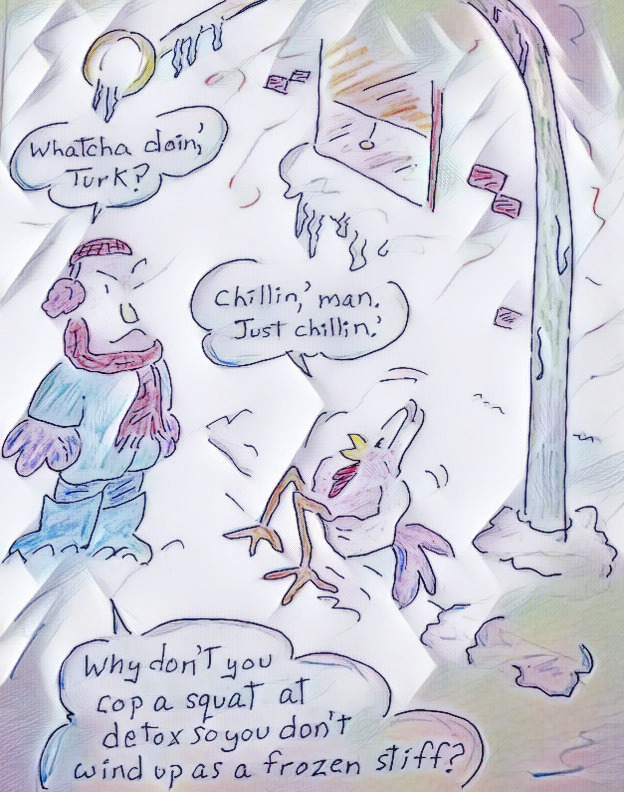
Addiction is shown by what happens when you suddenly stop using some chem or other (go "cold turkey").

The brain-body goes from feeling  good while high to feeling rotten  while deprived of the drug or alcohol. Your brain-body goes from one extreme to the other, from a pleasurable high to a nasty low.


A person who is really hooked on alcohol or some other drug may face a tough time quitting safely. Suddenly halting its use may bring on dangerous hallucinations and delusions, convulsions and death. Treatment at a medical detoxification unit may be in order. Some people really need to "go to detox" before they cease use entirely.

Consider the case of opioids like opium, morphine, heroin, fentanyl and various prescription pain pills and cough syrups.

Opioid withdrawal
You may have any of these situations, where you can go from
✓ Feeling really smooth to feeling really bummed out and in need of another hit of the chem.
✓ Numbness to pain.
✓ Dry mouth to sweating, runny nose, wet eyes, drooling and vomiting.
✓ Constipation to diarrhea.
✓ Slow pulse to rapid pulse.
✓ Shallow breathing and suppressed cough
to excessive yawning and coughing.
✓ Pinpoint pupils to very big pupils.
✓ Sluggish to super-jumpy with muscle cramps.
✓ Relaxed and chilled out to anxious, restless and unable to sleep.
CS2
Alcohol withdrawal
A sudden halt to drinking can be very dangerous to an alcohol addict.

A range of symptoms are possible, including:
✓ Headaches
✓ Anxiety
✓ Shakes
✓ Insomnia
✓ Fatigue
✓ Major mood shifts
✓ Digestive problems
✓ Pounding or fluttering heart
✓ Raised blood pressure
✓ Fast heart rate
✓ Overheated body
✓ Rapid abnormal breathing
✓ Hallucinations
✓ Seizures (that may lead to death)
CS3
Crack and meth withdrawal
Signs of meth withdrawal include,
✓ Red and itchy eyes
✓ Fever
✓ Anxiety
✓ Shakes
✓ Nausea
✓ Mild paranoia
✓ Hallucinations
✓ Agitation
✓ Excessive sweating
✓ Increased appetite
✓ Low energy and fatigue
✓ Lack of motivation
✓ Trouble sleeping
✓ Decreased sexual pleasure
✓ Suicidal thoughts
✓ Severe depression
✓ Dehydration
Signs of crack withdrawal include,
✓ Depression
✓ Irritability
✓ Extreme fatigue
✓ Increased appetite
✓ Increased need for sleep
✓ Vivid, unpleasant dreams
✓ Anxiety
✓ Severe drug cravings
✓ Psychosis
CS4
Dolly: Jolene
Ellen: Jolene

The long arm of addiction
People who think they have beaten addiction can face flashback cravings that trigger a relapse. Something in the surroundings reminds the brain of its previous condition and it snaps back to its addict mode.

Once an addict or alcoholic has stopped using or drinking, the mind can be pretty blurry for maybe three to six months.

Are you mokus?
"Mokus" is slang for "mind out of focus" and refers to alcoholics and addicts in the first stage of recovery. Do you see yourself in the items below?
✓ Fuzzy thinking and at a loss for the "right" words.
✓ Messed up memory.
✓ Get mad or bummed out way too fast.
✓ Your mood is on a crazy roller coaster.
✓ Can't sleep right.
✓ Often dizzy and so clunky you can't hold
a cup of coffee without spilling it.
✓ Managing stress is not your thing.
You don't have to have all these symptoms to be mokus.

CS5
Addiction can be very tough to beat, and often requires support from other recovering addicts and alcoholics. In many cases, it's hard to draw a line between mental obsession and physical compulsion.

In some cases, the brain's circuitry has gotten so messed up by alcohol or a drug — or some combination — that longterm treatment in an institution is necessary. Younger persons can land in this boat surprisingly fast.

CS6
W. Zevon: Werewolves of London

The author of The Funny Stuff Funnies takes sole responsibility for the content of this e-booklet. This booklet has not been sponsored, either directly or indirectly, by any government or non-government organization or fellowship, such as AA or NA.
Go to NEXT page.
Find table of content for Funny Stuff Funnies at this link.
The Lunapic image editor contributed greatly to this booklet's pictorial enhancement. Other image editors used were Palette and Petalica.
website hits counter
Do your friends and your friends' kids a favor, and post one or more Funny Stuff links on social media.

What are abuse and addiction?


As a public service, NEWS of the WORLD reprints The FUNNY STUFF FUNNIES, an educational comic book giving basic facts on drugs and alcohol. Each post reproduces a page from the booklet, which is aimed at young persons and which avoids sermonizing and excessive wordiness.

VIII
Tap phone images for better views.
AB1
If you are the person who might be abusing a chem, you may find it hard to believe that you may have a serious problem. Yet you can easily see that someone else is abusing something when its use interferes with school or work, or with family or social life. Sometimes the user endangers self or others.

Do you repeatedly get into hassles on account of drug runs or drinking bouts? Have you tried to slow down or stop, but, for one reason or another, keep using?

Have people hinted, or even told you bluntly, that you might want to slow down? When people talk that way, do you get really, really mad? Do you believe you're too young to be an addict or alcoholic?

Have you missed out on major opportunities because you  were partying, crashed
AB2
out  or hung over?

And don't forget, many a non-addict has greatly regretted the day she or he took one dose of something or other at a party.

Alcohol and drugs don't care who you are. It's just about impossible to predict who will become an alcoholic or addict. Addiction strikes down every type of person from every walk of life and with every type of childhood and every type of personal philosophy. It's just dumb to take "John Barleycorn" (booze) or his cousin "Delilah" (drugs) for granted.

You may think you can stop using at any time. But
a. Just to be sure, why don't you try stopping?
b. If you stop, do you pick up something else?
Alcoholics and addicts very frequently use more than one chem, both together and separately, and whether the "drug of choice" is available or not.

The need to be naughty
We all need to "let off steam" sometimes. We need, in fact, to be naughty.

Think about the kind of entertainment we like. Or what about the jokes that make us laugh out loud? We like to drop the mask and let go of our real feelings a bit. It's sort of a throwback to the play of childhood.

Now some people think that alcoholism or addiction is mostly in the genes. They
AB3
might even think they're immune.

Yet they haven't noticed that the lure of most of this stuff is lowered inhibitions and (at first) a ramped-up sense of play and freedom. In fact, some people have such a strong need to be naughty (to tell the universe: F everything), that they get big thrills from the chaos that comes with their usage. They relish throwing the chains of "mature responsibility" out the window.

What is addiction?
Anyway, as we know, abuse of intoxicants can lead to addiction. But what exactly is addiction? In previous decades, addiction meant that the victim suffered from
AB4
obvious physical withdrawal symptoms, a situation that can be very dangerous. That's why in the past such things as nicotine and cocaine were considered non-addictive, in the medical sense. (And cocaine dosages were typically lower then than they usually are now.)

But these days addiction is defined differently, more in accord with how most people use the word: A user finds attempts to stop a particular chem habit very difficult; repeated tries often end in failure. "Will power" is rarely enough.

Addiction can creep up even though you find that not every experience is fun. And some are downright awful. As long as you find strong pleasure or relief from a drug off and on, you can become addicted. In  fact, intermittent  reinforcement is a  very
AB5
effective way of instilling a bad habit. According to experts, the user has -- without noticing it -- rewired the brain in such a way that brain and body conspire together to keep the alcohol or drug habit going.

This sly rewiring happens at different rates in different people. For example,
✓ Women who drink a lot face the prospect of alcoholic addiction much sooner than a typical adult male.
That may be related to the fact that women's digestive systems don't neutralize alcohol as fast as men's. The situation is similar for barbiturates.

✓ It may take five years of heavy drinking before a typical adult male above age 24 reaches full-blown alcoholism.

✓ People who begin drinking as teenagers face a major risk of reaching alcoholism within only a few months.
That's because young nervous systems are more strongly imprinted by alcohol (or drug) highs than is the case among adults. Also, researchers have found that a few binges can actually short-circuit the "stop" signals inside youthful brains.

✓ Most -- but not all -- alcoholics and addicts started fooling around with substances before age 25.
That even goes for nicotine. And yet...

✓ Aging can also influence vulnerability.
Once you pass age 30, your liver is less and less able to process alcohol and drugs such as sedatives, meaning you may get drunk or stoned faster and faster.

✓ Still, heavy drinkers may find that over time they require more and more alcohol to get the effect they want. Their "tolerance" of alcohol keeps increasing.
Tolerance is a sign that you're far along the road to addiction or are already addicted.
AB6
Linda: Poor, Poor, Pitiful Me
✓ In late-stage alcoholism, some drinkers suddenly experience "reverse tolerance."
Even one drink gets them drunk. Reverse tolerance is a very bad sign: the liver is so badly damaged that alcohol keeps recycling through the body.

✓ Then there is "inverse tolerance." The brain rewires with usage so as to obtain the high faster.
For example, some new users try marijuana or cocaine for months with little effect. But then one day the chem takes hold big time. The new norm could be so strong that health and safety are jeopardized.

✓ Body size is an important issue.
Alcohol or drugs are diluted less -- and concentrated more -- in the bloodstreams of smaller persons than they are in larger persons. So a small person may reach intoxication faster than a large person taking the same dose.

✓ People of all ages and all types can become addicted to crack cocaine after only a very few uses.
The chem spurs a rewiring of the brain that sets up an incessant demand for more, more, more.
AB7
Out of control
When you go from fooling around with mind-altering chems now and then to hard-core addiction, you experience some or all of the following signs:
✓ More is your continued attitude to the chem.
✓ You can't quit and even cutting down stresses you out.
✓ The chem eats up a lot of your time -- either from hustling to get it or from being out of action after usage, or both.
✓ To placate your chem need, you quit hanging out with certain friends, stop doing some or all of the fun things you once liked doing, and even dodge certain types of work or school goals.
✓ You know the chem is messing up your head and your body, but you keep using it.
✓ You can't start your day without a hit of your favorite chem.
✓ You resent anybody mentioning your chem dependence.
✓ You become unhappy and possibly physically sick when the chem is unavailable.
✓ You keep counteracting your body's attempt to detoxify your system by upping the dosage to get the high you want.
(The American Psychiatric Association takes a medical approach to the terms "abuse" and "addiction." The view of the doctors is pretty much the same as what's been said so far.)

Many chem addicts also deal with other compulsive behavors -- like frenzied gambling and the thrill of foolish risk-taking. And both chem-based and non-chem compulsions alter brain chemistry in similar ways.

But this booklet is focused on drugs and alcohol. Consult other sources for information on other problems.

For more about abuse and addiction, check the pages about specific chems.
AB8
The author of The Funny Stuff Funnies takes sole responsibility for the content of this e-booklet. This booklet has not been sponsored, either directly or indirectly, by any government or non-government organization or fellowship, such as AA or NA.
Go to NEXT page.
Find table of content for Funny Stuff Funnies at this link.
The Lunapic image editor contributed greatly to this booklet's pictorial enhancement. Other image editors used were Palette and Petalica.
website hits counter
Do your friends and your friends' kids a favor, and post one or more Funny Stuff links on social media.

Mixed up and overloaded


As a public service, NEWS of the WORLD reprints The FUNNY STUFF FUNNIES, an educational comic book giving basic facts on drugs and alcohol. Each post reproduces a page from the booklet, which is aimed at young persons and which avoids sermonizing and excessive wordiness.

VII
Tap phone images for better views.
MX1
Mixing alcohol with other drugs and medicines is risky. You might make the medicine useless. You might end up with a far bigger punch than you expect.

Many people have died after taking downers, like benzos or barbiturates, and drinking alcohol.

People who mix uppers -- like amphetamines -- and downers risk temporary insanity. People have been known to kill themselves while in the midst of drug-induced psychosis.

Enormous amounts of alcohol guzzled quickly can kill you. Your nervous system shuts down, thus switching off your heart and lungs. Bang! You're dead.

Heavy drinking for even a few years can cause a lot of damage inside -- including to the liver and brain. It often happens that such damage cannot be reversed.

MX2
Trash
Some people will swallow anything and everything -- all in a short time. That's why they are called trash heads.

Too much of any one drug may be harmful. And since "too much" depends on things like age, sex, weight and health, how can you be sure how much is too much? Knowing how many milligrams are in a particular dose may not be especially useful.

Pharmacists often warn against drug mixes precisely because the two (or more) acting together is much more dangerous than either one acting alone. Many thousands of people have suffered grievously -- even died -- from such mixing.

One trio to avoid: uppers, downers and alcohol. Cocaine, benzos and rum is an example of a combo that can lead to violent insanity and ruined lives -- yours included.
For more on alcohol, please go to the alcohol page.
For more on other downers, please go to the downers page.
MX3


The author of The Funny Stuff Funnies takes sole responsibility for the content of this e-booklet. This booklet has not been sponsored, either directly or indirectly, by any government or non-government organization or fellowship, such as AA or NA.
Go to NEXT page.
Find table of content for Funny Stuff Funnies at this link.
The Lunapic image editor contributed greatly to this booklet's pictorial enhancement. Other image editors used were Palette and Petalica.
website hits counter
Do your friends and your friends' kids a favor, and post one or more Funny Stuff links on social media.

Beer, wine or liquor? How strong is the hootch?


As a public service, NEWS of the WORLD reprints The FUNNY STUFF FUNNIES, an educational comic book giving basic facts on drugs and alcohol. Each post reproduces a page from the booklet, which is aimed at young persons and which avoids sermonizing and excessive wordiness.

VI
Tap phone images for better views.
BW1
Percentages
In the United States, beer contains about 5 percent alcohol. Light beer contains about 4.2 percent.

Pale ale is about the strength of beer. But dark ale carries a bit more kick, at 6.5 percent alcohol.

Wine runs anywhere from 5.5 percent to 16 percent alcohol, with the average at 11.5 percent.

Fortified wine is wine that comes pre-mixed with a distilled spirit, like brandy. The product holds between 15.5 and 25 percent alcohol, with the average at 18 percent.

Liquor is the "strong stuff" containing 35 to 40 percent alcohol. When you read the label and see "80 proof," that means the drink is 40 percent alcohol. Proof is roughly double the alcohol content.

Some hard stuff from the "stills in the hills" comes as high as 160 proof (80 percent alcohol). The grain alcohol Everclear sells at from 60 to 95 percent alcohol. The maker advises against drinking it straight, urging that it be diluted first.

Sometimes liquor is called hard liquor or distilled spirits. Liquor comes in many forms, including whiskey, vodka, rum, tequila, gin. While beer and wine require fermentation, liquor also requires distillation.

There is another drink known as liqueur, which runs at 15 to 30 percent alcohol. Liqueur is a concoction of distilled spirits and one or more flavorful sweeteners.
BW2
Just so ya know
Fermentation occurs when yeast microbes consume the organic material (usually grain or grapes) and excrete it as ethanol (the type of alcohol people drink).

Distillation is a method of filtering out non-alcoholic parts of the fermented material (mash or liquid). A "still" heats the mash or liquid and a funnel captures the alcohol vapors and diverts them into another container, where the vapors condense and become liquid. But this second liquid contains a much higher percentage of alcohol than the first liquid or mash.

Brewers use enzymes to convert starches to sugar (the same process your body uses). The result is a pulpy, wet mix called mash.

Winemakers use yeast to convert the fruit sugars glucose and fructose into alcohol. Grapes or other fruits are crushed into a pulpy, wet mix called must. At some point, the solids are filtered out and yeasts are added.

When yeast and sugar get together, you get carbon dioxide and alcohol.

The author of The Funny Stuff Funnies takes sole responsibility for the content of this e-booklet. This booklet has not been sponsored, either directly or indirectly, by any government or non-government organization or fellowship, such as AA or NA.
Go to NEXT page.
Find table of content for Funny Stuff Funnies at this link.
The Lunapic image editor contributed greatly to this booklet's pictorial enhancement. Other image editors used were Palette and Petalica.
website hits counter
Do your friends and your friends' kids a favor, and post one or more Funny Stuff links on social media.

Why do people drink?


As a public service, NEWS of the WORLD reprints The FUNNY STUFF FUNNIES, an educational comic book giving basic facts on drugs and alcohol. Each post reproduces a page from the booklet, which is aimed at young persons and which avoids sermonizing and excessive wordiness.

V
Tap phone images for better views.
WY1
Many people are -- when you get down to it -- shy and tense.
Some people use drink to help them socialize more easily at parties or among friends.
Some people drink to impress others.
When you think about it, what's the real payoff for you?
Some people don't want to drink that much, but don't want to be left out.
Sometimes a person just has to have the guts to risk being left out, even if that means changing social circles.
Some people rely on booze to pave the way to sex with another.
Such people are sexually hung-up and lack respect for the other person. See Sex and chems.
Some people see getting drunk as their main way of feeling free and having fun.
If that's your bag, you're in trouble. Do you need help? Then check the Help page.
Some people drink out of boredom.
Boredom is often a symptom of unacknowledged depression. Try something else: Call a friend, go for a walk, say hello to someone you don't even know.
Some people drink in order to vent anger.
If you are unable to tell people how you really feel when you're sober, try working off your frustration: go to the gym, go for a jog or brisk walk, fix that thing that you've been putting off fixing...
WY2
The author of The Funny Stuff Funnies takes sole responsibility for the content of this e-booklet. This booklet has not been sponsored, either directly or indirectly, by any government or non-government organization or fellowship, such as AA or NA.
Go to the NEXT page.
Find table of content for Funny Stuff Funnies at this link.

The Lunapic image editor contributed greatly to this booklet's pictorial enhancement. Other image editors used were Palette and Petalica.
website hits counter
Do your friends and your friends' kids a favor, and post one or more Funny Stuff links on social media.

Signs of alcohol trouble


As a public service, NEWS of the WORLD reprints The FUNNY STUFF FUNNIES, an educational comic book giving basic facts on drugs and alcohol. Each post reproduces a page from the booklet, which is aimed at young persons and which avoids sermonizing and excessive wordiness.

IV
Tap phone images for better views.
SN1
If you have even one of these signs, you might want to think long and hard about your situation.
You get into trouble because of your drinking.
Reading this booklet on chems and alcohol makes you really uptight.
You are drinking more because you "really enjoy it." Actually, there is something eating you against which you feel powerless.
You get drunk almost every weekend.
You need "one or two" nearly every day.
You keep "going on the wagon."
You think about booze a lot.
You arrive at parties and social affairs already well-oiled.
You have begun to lose friends who don't party like you do (even though you may make new ones easily).
You have blackouts. The next day, you can't remember what happened while you were drinking.
You drink to get rid of a hangover.
Once you take a drink, you find it hard to refuse another. In fact, you hardly think about it.
You make excuses about your drinking.
Your family makes excuses about your drinking.
Once you start drinking, you can't stop.
You go on long binges -- you just can't help it.
Just because you don't have all of these signs doesn't mean you don't have a problem. Any one sign shows that something isn't right.
SN2
The author of The Funny Stuff Funnies takes sole responsibility for the content of this e-booklet. This booklet has not been sponsored, either directly or indirectly, by any government or non-government organization or fellowship, such as AA or NA.
Go to NEXT page.
Find table of content for Funny Stuff Funnies at this link.
The Lunapic image editor contributed greatly to this booklet's pictorial enhancement. Other image editors used were Palette and Petalica.
website hits counter
Do your friends and your friends' kids a favor, and post one or more Funny Stuff links on social media.

Psychotronic mind games